Category Archives: Personal Success

THINK Your Way to Success!

At birth, each and every one of us is endowed with the most powerful piece of equipment known to humankind: the brain!

Our brain comes to us free and clear. Often, things that are free are taken for granted. The brain is no exception.

With it, “the collective we” have built rocket ships, skyscrapers and computers. We have conquered major diseases and I know one day we will conquer cancer. All through effective use of the human mind.

It matters not the size of the brain. In one of Earl Nightingale’s programs we learn that the largest brain ever recorded was that of an idiot and the smallest was that of a genius.

It matters not the circumstance. We’ve each observed people who came from nothing (minimal to no “formal” education, severe handicaps, and the like) and made it big – REALLY BIG!

So, why are there “so few” who truly fulfill their dreams? By and large, we don’t THINK.

Getting up in the morning to an alarm, brushing one’s teeth, grabbing a cup of coffee, driving to work takes NO thinking. How many times have we arrived at our job and said “Man, I don’t remember the drive! How did I get here?” We were on auto-pilot.

Then, while at work we “go through the motions” until the 5 o’clock bell rings and head home, only to go through the same process again the following day. While we may be doing what it takes to earn a paycheck, there is so much more…

This whole “THINKING” thing really hit home for me back in the early 90’s. I was working for a cellular telephone company in Atlanta, GA. I led an IT team responsible for maintaining and enhancing the core business application we used to manage customer subscriptions, credit, invoicing, collections and customer care.

The firm engaged “the guru” who knew how to make the operating system, that our cellular management information system was running on, hum. Because we were growing so fast the application wasn’t keeping up performance-wise, so we needed to do some major tuning. Time was of the essence!

This guru (which he definitely was) really knew his stuff! He made a number of recommendations which we implemented with great success. However, he also made a set of “foundational recommendations” that were pretty far sweeping (and high risk). I was placed in the role of evaluating the potential risk and impact of implementing these changes. I thought: “What, me, a lowly team leader, up against “the guru” of the operating system?” I was a “little” stressed, to say the least.

But, I got started…The first thing I did was draw a diagram of the application landscape (all the moving parts) on my whiteboard. I “was” the expert on this. I had been in just about every nook and cranny of this application, broke a few things myself and fixed way more (which is why I was still in the role 🙂 ).

Then, each morning before others arrived at work and in the evening after everyone left I would sit, stare at that diagram and THINK. I would ask myself: “What would his [the guru’s] recommendation mean here, and here, and here?” This went on for several days. And, the outcome was nothing short of amazing. I could not believe the number of epiphanies that I had. While I certainly was no match for “the guru’s” knowledge of the operating system, I was able to identify numerous issues and risks that would have brought this mission critical application to its knees.

Now, frequent readers of this blog know that I am a person that looks for ways to “make things happen.” In this case, the thing I was asked to “make happen” was ensuring our core application survived the guru.

After gathering and organizing all my notes I was asked to present my findings to the CIO, COO and several others, including “the guru.” In summary, the “foundational recommendations” were nixed. We achieved the necessary performance improvements via other means.

This experience taught me a valuable lesson that I try to impart to others when they say something like “But I don’t know how to do this.” My response is: “If you DID know how to do this, what would you do first, second, etc.” Initially, they look at me like I have 2 heads.

The point: I’m NOT going to tell them how to do something until they’ve at least demonstrated that they’ve tried to THINK about how they might do it. Once they’ve done that they can share their thoughts and ideas with me at which time I can provide guidance.

Too often people either decide not to do something, because they’ve never done it before, or they ask someone else how before sitting down and firing up their thinking apparatus.

Give this a try. The next time you are confused, unsure of a situation or assignment, or just plain stressed, sit down with a piece of paper. Write out the problem being faced and then THINK. What is the true problem? What are the possible outcomes (good and bad)? What are steps that I can take to address this? Turn it over and over in your mind, writing down the ideas that come up. You will be amazed at just how much you really do know.

Then, organize your thoughts and ideas into a plan of action.

If it is high risk and/or highly complex now would be time to run your thoughts and ideas by someone else (preferably a trusted advisor, someone who has faced similar challenges in the past). Then act! Remember, as long as your ideas are “directionally correct” you are on your way. Monitor your progress. If you get off track a bit, simply adjust as you go.

As we do this process over and over again we soon  realize just how powerful our minds are — WHEN WE ACTUALLY THINK!
Moving From Worry to Action!

It is important to listen when our spidey senses are tingling. They are telling us that something needs attention. It could be our health (I really need to exercise more), education (I hope I ace that upcoming test), family (I need to spend more time with…), finances (Am I saving enough for retirement?), job (I need to coordinate that meeting to address…) and the all-encompassing “What if…?”

However, we must ask ourselves “Am I just worrying or am I doing something about it?

One definition of worry is: give way to anxiety or unease; allow one’s mind to dwell on difficulty or troubles.

Worrying is like putting our car up on blocks, starting the engine and putting our foot to the floor. Our wheels are spinning to be sure. But, we have no traction and are burning fuel with absolutely no forward momentum or positive outcome. We are wasting valuable energy that could otherwise be put to good use.

At a high level, there are 2 sources of worry:

  1. Things we can do something about (areas in our control).
  2. Things we can do nothing about (areas outside of our control).

Let’s address the 2nd item 1st. For things we can do “absolutely” nothing about the best approach is to change our attitude (instead of continuing to “rail against reality”) and focus our energy on things we CAN do something about.

Several years ago a good friend was planning an overseas mission trip to a third world country. With any trip there are details to consider to ensure safety and comfort. In this case, there were many additional variables including: several modes of transportation through numerous countries (planes, trains, automobiles and border crossings), not knowing the local languages along the way (will I be able to communicate, read the signs, miss my stop?), comfort (over 24 hours of travel under these conditions with minimal sleep) and finally ensuring everything comes together (will we accomplish our objective of helping some people in need?).

As she was discussing the upcoming trip it was clear she was worrying (as any of us would!). An epiphany that was shared (which I “believe” helped) was: When we worry about things we often fast forward through numerous potential scenarios and possible outcomes — in an instant. Yet, the reality is that we seldom encounter these potential scenarios in a single “flash”, if they happen at all.

I am an old man and have known a great many troubles, but most of them never happened.” ~ Mark Twain

More often than not when situations do present themselves, they occur “individually” providing ample time to address each. While that may be what happens in the “real world”, we dramatically accelerate things in our “thought world.” Our brains are extremely powerful; they work at lightening speed and can easily overwhelm us if we don’t control our mind and appropriately direct our thoughts.

So, when our spidey senses are “lit up” let’s use that energy to:

  • Think – What is the issue (or issues) I’m concerned about? What are the options and ideas that I can consider in response?
  • Plan – Which idea(s) should I execute on, when, how and with whom?
  • Act – Put the plan into action – Immediately!

The reason why worry kills more people than work is that more people worry than work.” ~ Robert Frost

Because our brains work at lightening speed this simple process (think, plan and act) need not take days or even hours. We can use our incredibly powerful minds to go from worry to action in MINUTES!

We all worry (to some extent). The key is to quickly detect when we are in the worry-mode and convert that energy into action!

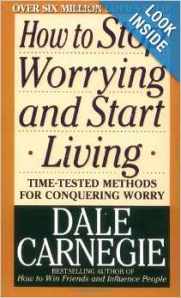
Want a fantastic book on conquering worry? Check out this recommended reading:

download (1)

An email Worth $200!?!

On a fairly frequent basis I’ve had to suggest to my 3 youngest sons that they check their email as I had just sent them something important (or funny). Being completely text-based, email just isn’t a priority for them. While I too am a texter, these are (if anything) short, temporary flashes of information not meant to live past the moment.

I’ve often thought of sending an email indicating that the first to respond within 24 hours will earn $100. I haven’t done so, as I think this would be a waste of my time 🙂

Could an email message be worth $200? Why, yes it could. Here is an example.

In December we sold the car of one of our sons, to a young man from “away.” During the last stage of negotiation he tried to get me to drop the price by another $200. I held firm, he took the car. As he drove off my son said “Dad, did you let him know about the windows not working properly and that they come down when on the highway?” I felt terrible, as he had test driven the car in our neighborhood (low-speed) and on a cold winter day (when he wouldn’t have tried taking the windows down).

His contact with me via craigslist had been through email. So, I sent him a message to let him know that I’d be happy to send him the $200 because I had totally spaced the malfunctioning windows, asking him to confirm the address to send the check to. We received his response several days ago, as follows:

Sorry for taking so long to respond to your message, I haven’t opened my email in over 6 months. I would greatly appreciate the check as I had to have both the windows fixed anyway for it to pass inspection. The total was around $200. Thank you for your honesty and again, I apologize for the delay.

Although I had completely written him off months ago, I sent him a check.

I’ve heard adults say similar things. How can this be?!? If we have an email address, how can we, in all good conscience, not open our email for a period any longer than 1-2 days?

Saying that I haven’t opened my email in 3 (or more) days is like saying I haven’t gone to my US Postal mailbox in 3 (or more) days.

Increasingly email is replacing paper mail (as it should)! We are burning through the forests of our planet to create paper when (I’d suggest) over 90% of this waste can be handled electronically. Whether we like it or not (and I love it!), email is increasingly becoming the method that firms we do business with want to communicate with us. This includes our school, bank, employer, insurance company, electric company, etc.

Given that fact, it is important to check our e-mailbox daily, or at least every couple of days.

I know, I know…Some may say: “Each time I go to my email box it is full of spam (junk mail).” Or, “There are so many emails in there I just don’t have the time.

What if there is a message from an institution you do business with or containing some important information being shared by a family member or friend (for which Facebook is inappropriate)? Ignorance of the message is no excuse for “missing it” (a bill, late notice, important date or event, etc.).

There are some very simple methods to manage an email inbox so that it isn’t full of clutter. Here are steps I’ve found effective:

  1. Use Gmail (it is free and doesn’t need to change each time we switch Internet Service Providers): Any junk mail received is automatically filtered into its own (Spam) folder. I don’t have to do a thing. On occasion I’ll check the junk folder to see if anything was incorrectly flagged, and have never found a problem (in years). Other email clients have similar functions. And, if they don’t, or don’t work effectively — then we can switch!
  2. Use the same time management method as handling paper mail. That is, touch it once and only once. Upon opening a message there are 3 simple options: 1) Respond / handle immediately and/or, 2) Delete it, or 3) File it (in a folder separate from the inbox) for future reference. To support this we might have folders for personal, finance, job/career/business, church, etc.

If you were to view my inbox you would seldom see more than 4-5 emails. Anything more than this and I know I’m not handling something that is awaiting my attention.

A guideline to consider would be: if there are more emails in the inbox than can be displayed on the first screen then cleanup is required. The question to ask ourselves is: How many times do I want to chew my cud (that is, repeatedly review a continuously growing inbox looking for items to be handled)? I HATE wasting time 🙂

In closing, it is extremely beneficial to treat our email inbox with MORE diligence than our paper mail box. And, to contribute to the “green” cause, we can increasingly go paperless by requesting that firms we do business with send us correspondence via email and stop sending paper!