Category Archives: Business Success

Landing A Professional Job – Pulling It All Together

Several months ago I published a number of posts on the topic of Landing that “first” professional job. In summary, the posts outline the plan my oldest son followed after receiving his Bachelor’s Degree in Web Design and Interactive Media.

The great news is that he is now working full-time at a firm which provides e-commerce solutions for retail companies around the globe! And, earning a significant salary 🙂

Since it is graduation time for many college students, I thought it would be a good time to provide an index to this content, making it easier for those who may be striving to land their first “professional” job. And, to be clear, the content also serves those looking to change jobs and/or careers.

Here is my eBook, on the topic of Landing A Professional Job.

The topics covered are listed below. Simply click on each to be transported to the respective post.

In closing, I wish you the best in landing your:

  • First professional job, after receiving a college degree
  • New, more rewarding job, if you’ve outgrown the one you’ve held for years (even decades)…
Tagged

Launching A Consulting Business – The Image

Several months ago I “thought” I had completed the series on Launching a Consulting Business, with the post which provided an index to the 25 + articles written on the subject.

I just realized, I wasn’t done 🙂

Before going into this latest topic…

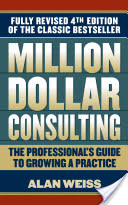
A current “rock start” management consultant is Alan Weiss. Prior to launching my own consulting business I read his books and attended events where he spoke. Bottom-line: He shares a wealth of knowledge on the topic of being a successful management consultant!

As such, if you are considering this path, or would like to take your consulting business to the next level, then the following book by Mr. Weiss is highly recommended. Simply click on the image and you’ll be transported to Amazon.com to get your copy!
content

Now, let’s cover the latest topic…The Image.

As Mr. Weiss points out, clients (prospective and existing) want to associate with success. Any consultant that a client may engage, therefore, must have an image of success or they will NOT be as attractive a candidate to bring in to their company, under their good name.

This image includes our:

  • Dress code
  • Tools
  • Automobile
  • Emotions and Mannerisms

Reality is, people DO judge a book by it’s cover…

Let’s now cover each of our “covers.”

Dress Code

I recall, when I still worked in Corporate America many years ago, as VP of Customer Care, one of the Sales guys called me and said: “Craig, we need you to dress-up again like James Bond, for an upcoming meeting.”

Wow, I thought…I’ve never been compared to James Bond, but I can live with it 🙂

What he meant was, get on your best suit because we’re going to meet a customer.

The guiding principle here is, at least for the first impression, to dress at a level above how we expect our client to be dressed. For me, this means putting on my best suit, crispy white shirt, tie and polished shoes. It may turn out that this “is” the dress code for some companies. Thankfully, the dress code for many of my clients is business casual, which is the attire I’ll then don after the initial “meet and greets” have taken place.

I happen to top my suit off with a gold Cross pen in my shirt pocket. I recall one of my sons commenting: “Dad, you hammer on being frugal. Why the heck would you spend $50 on a pen? And, why do you need a pen anyway, if you are pushing for a paperless world?

Out of the mouthes of babes…Very good questions…

My response – The high-end pen is part of the image. And, while I might want to push for paperless, some clients still ask that I execute contracts with ink. I ALWAYS want to be prepared for that.

So there 🙂

Tools

While we covered tools in the post Be Equipped I thought it important to reinforce and expand on this here.

First, not only do you want a laptop that has significant horsepower, it must “look good.” This includes making sure it is clean and not all banged-up. And, in keeping with our dress attire, it ought to be as good as (or better) than what the prospective client has. Why? Because YOU are supposed to demonstrate that you are leading edge.

You’ll also want to have the common tools of collaboration. For example, Webex…I cannot tell you how many client meetings I’ve been invited to and, upon attending, observe that one or more invitees could not attend in person – they needed to dial-in. The meeting organizer hadn’t considered this very real and highly typical possibility (REPEATEDLY).

What emerges is a very simple example of how and where the “power consultant” can shine by jumping in and offering to IMMEDIATELY launch a Webex session to enable remote attendees to participate. This, while the facilitator proceeds with his/her meeting.

While this may be a little thing, the simple gesture demonstrates that you are “always ready” to remove obstacles and ensure things move forward smoothly.

Again, instead of going into the topic of tools for the power consulting, in more detail, feel free to read the previous post on this topic (Be Equipped).

Automobile

Our transportation says a lot about us. This does NOT mean we should drive a BMW or Mercedes. What it does mean is that our vehicle must be:

  • In good working order (not constantly breaking down, causing late arrivals, missed meetings or deadlines)
  • Reasonably new (no rust, dings or dents)
  • Clean, especially inside, for that occasion when we take a client out to lunch

Emotions and Mannerisms

Back to James Bond.

Have you ever seen him truly stressed out? I can’t say that I have. He always keeps his cool; never blows his top. Calm, cool and collected. That is the image of a power consultant.

Another analogy…We must be like a duck gracefully crossing the lake. Rain (or anything else that hits us) simply rolls off our back (at least this is what people see on the surface). But, underneath the surface we are paddling (thinking, planning, strategizing) like crazy.

Bottom-line: We cannot let things ruffle us. Our clients look at us as problem solvers. They do NOT expect us to commiserate (wallow around in the mud) with them.

In closing, all of the above may seem superficial to some. Perhaps they aren’t living in the real world 🙂

Those who want to be considered (and paid as) a power consultant should NOT take these things lightly. Trust me and just do it…

All the best!

Click here to review the next article in the series.

Why didn’t I get that promotion?!?

Have you ever asked yourself that question?

Every one of us has, or will at some point in time, witness a colleague receiving a promotion for which it would seem we were just as suitable a candidate.

While we might wonder why this happened, the truly mature person at this point is happy for and congratulates their colleague for their accomplishment.

Too often people feel that when someone moves ahead of them it is because of “who they know” or even something as devious as “they must have pictures.” 🙂 While this may be the case in the rare / exception scenario it really is more likely that the person who was promoted was quite simply more qualified for the expanded role (and higher pay).

What?!?! Some might ask. I work just as hard as they do. And, I’ve been in the job much longer than they have.

Hardly an entitlement for a promotion…

To increase our pay via an expanded role we must increase our value so that it is commensurate with the role we seek.

I’m presently on break (in Puerto Rico) in the middle of a client engagement for which we are defining the core competencies that are required for each role and level within a particular organization.

To keep my mind “in gear” for this project I thought I’d dash out a quick blog-post on the topic.

At a high-level, there are 3 categories of core competencies that one must consider as they move up the corporate ladder, regardless of industry.

  1. Dealing with People
  2. Dealing with Business
  3. Dealing with Self

Now, let’s expand on (list out) the core competencies that one must be especially effective in, at each level of an organization. Some competencies need no further explanation, while others required a bit of commentary.

Here we go…

Individual Contributor

Individual contributor roles can have many levels, from the entry-level associate to lead individual contributor. And, to grow from that entry-level to lead role one must be increasingly effective at the following core competencies.

  • Customer Orientation – Internal/other department or external/paying customer
  • Oral and Written Communication
  • Being a Team Player – Putting the team / organization before self
  • Thoroughness and Completeness
  • Stress Management
  • Technical Acumen – MS Office, business systems, Internet, etc.
  • Diagnostic Information Gathering – The ability to tease information out of a situation to subsequently take the next appropriate steps
  • Analytical Thinking

Then, to rise to the level of lead individual contributor one must demonstrate the following:

  • Initiative – Doing the right things at the right times without being asked or told to do so.
  • Conceptual Thinking – The ability to find effective solutions by taking a holistic, abstract, or theoretical perspective.
  • Managing / Dealing with (the ONLY constant) Change
  • Self Confidence – Faith in one’s own ideas and capability to be successful; willingness to take an independent position in the face of opposition.
  • Interpersonal Awareness – Being aware of, in tune with and handling interpersonal interactions in ways that demonstrate empathy towards others.
  • Entrepreneurial Thinking – Constantly identifying ways and means to do things faster and/or more easily to increase profit (increase revenue and/or decrease cost).
  • Persuasive Communication – The ability to communicate via oral and written means in a way that makes an impact and persuades the intended audience.
  • Personal Credibility – Demonstrated concern that one be perceived as responsible, reliable, and trustworthy.

Team Lead to Manager

The biggest career leap anyone will make is from an individual contributor (managing only one’s self) to that of team lead, supervisor or manager (leading others). To continue moving up the ladder one must increasingly demonstrate the above, as well as show an aptitude for growing in the following areas:

  • Providing Motivational Support – Enhancing others’ commitment to their work.
  • Empowering Others – Conveying confidence when assigning complex / new duties, allowing employees freedom to decide how they will accomplish their tasks.
  • Developing Others – Thoughtfully delegating work and providing the necessary coaching to develop their capabilities.
  • Managing Performance – Taking responsibility for the team’s performance by setting clear goals and expectations, tracking progress, providing feedback and addressing performance problems promptly.
  • Attention to Communication – Ensuring information is passed on to others who should be kept informed.
  • Results Orientation – Focusing on the desired result of the team’s work, setting challenging goals, focusing attention on these goals and meeting or exceeding them.
  • Establishing Focus – Being able to develop and communicate the goals of the team or organization in support of the business’ mission.

Then, to be considered a higher-level leader a person must also demonstrate the following:

  • Decisiveness – The ability to make difficult decisions in a timely manner.
  • Influencing Others – The ability to influence others (gain support for projects, proposals, etc.) outside of their own unit (direct reports).
  • Building Collaborative Relationships – The ability to develop and strengthen partnerships with others inside and outside the organization who can provide information and assistance.
  • Forward Thinking – The ability to anticipate the implications and consequences of situations and taking appropriate action to be prepared for possible contingencies.

Senior Manager to VP

In addition to the above competencies, to be truly effective in the more senior roles in an organization one must demonstrate the following:

  • Strategic Thinking – The ability to analyze the organization’s competitive position by considering market and industry trends, existing and potential customers (internal and external), and strengths and weaknesses as compared to competitors.
  • Fostering Innovation – The ability to develop, sponsor, or support the introduction of new and improved methods, products, procedures, or technologies.

Some might say, “geez, it would seem many of these competencies could apply to most everyone (at every level) in the organization.” That is correct! However, to effectively manage career growth and development, it becomes important to focus on those areas that are most important at each level. Hence, the suggested progression of competencies outlined here.

So, if you ever find yourself asking the question “Why didn’t I get that promotion?” consider the above. And, feel free to politely and professionally ask your manager to provide feedback on any gap areas that you need to consider or competencies that you need to develop to be considered for the next opportunity. From there you can build a plan to grow in the required areas so you’ll be the top candidate for future opportunities.

I’d better stop now as the warm breeze is blowing sand onto the keyboard of my MacBook, as my wife and I sit on the beach…