Moving From Worry to Action!

It is important to listen when our spidey senses are tingling. They are telling us that something needs attention. It could be our health (I really need to exercise more), education (I hope I ace that upcoming test), family (I need to spend more time with…), finances (Am I saving enough for retirement?), job (I need to coordinate that meeting to address…) and the all-encompassing “What if…?”

However, we must ask ourselves “Am I just worrying or am I doing something about it?

One definition of worry is: give way to anxiety or unease; allow one’s mind to dwell on difficulty or troubles.

Worrying is like putting our car up on blocks, starting the engine and putting our foot to the floor. Our wheels are spinning to be sure. But, we have no traction and are burning fuel with absolutely no forward momentum or positive outcome. We are wasting valuable energy that could otherwise be put to good use.

At a high level, there are 2 sources of worry:

  1. Things we can do something about (areas in our control).
  2. Things we can do nothing about (areas outside of our control).

Let’s address the 2nd item 1st. For things we can do “absolutely” nothing about the best approach is to change our attitude (instead of continuing to “rail against reality”) and focus our energy on things we CAN do something about.

Several years ago a good friend was planning an overseas mission trip to a third world country. With any trip there are details to consider to ensure safety and comfort. In this case, there were many additional variables including: several modes of transportation through numerous countries (planes, trains, automobiles and border crossings), not knowing the local languages along the way (will I be able to communicate, read the signs, miss my stop?), comfort (over 24 hours of travel under these conditions with minimal sleep) and finally ensuring everything comes together (will we accomplish our objective of helping some people in need?).

As she was discussing the upcoming trip it was clear she was worrying (as any of us would!). An epiphany that was shared (which I “believe” helped) was: When we worry about things we often fast forward through numerous potential scenarios and possible outcomes — in an instant. Yet, the reality is that we seldom encounter these potential scenarios in a single “flash”, if they happen at all.

I am an old man and have known a great many troubles, but most of them never happened.” ~ Mark Twain

More often than not when situations do present themselves, they occur “individually” providing ample time to address each. While that may be what happens in the “real world”, we dramatically accelerate things in our “thought world.” Our brains are extremely powerful; they work at lightening speed and can easily overwhelm us if we don’t control our mind and appropriately direct our thoughts.

So, when our spidey senses are “lit up” let’s use that energy to:

  • Think – What is the issue (or issues) I’m concerned about? What are the options and ideas that I can consider in response?
  • Plan – Which idea(s) should I execute on, when, how and with whom?
  • Act – Put the plan into action – Immediately!

The reason why worry kills more people than work is that more people worry than work.” ~ Robert Frost

Because our brains work at lightening speed this simple process (think, plan and act) need not take days or even hours. We can use our incredibly powerful minds to go from worry to action in MINUTES!

We all worry (to some extent). The key is to quickly detect when we are in the worry-mode and convert that energy into action!

Want a fantastic book on conquering worry? Check out this recommended reading:
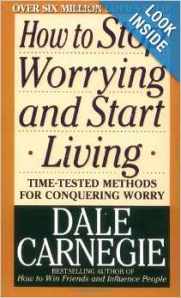
download (1)

Wait for the Bullet or Fall on the Sword?

In a prior post I covered a real-life scenario resulting from the lack of project management and how it was remedied. As promised, I’ll now share how we “peeled the customer off the ceiling” which became necessary as a result of our causing significant impact to their business.

Preparation for a client meeting of this nature is absolutely critical. This includes identifying the goals and objectives, key topics and who will cover each. In this particular situation, it became necessary to document the chronology of events to demonstrate to the client that we completely understood what happened. After extracting this information from the personnel involved in the incident, we were ready. A few of us put on our suits and went to visit the client.

The opening moments of a meeting such as this are the most crucial. After introductions, my opening went something like this:

The reason we are here is because we caused significant impact to your business, probably more significant than we realize. I am here to tell you that I take 100% responsibility and commit to you that it will not happen again. What we’d like to do is provide a walk-through of what happened, our key learns and what we’ve done to ensure that this will not happen again. Will that work for you?

The client went with my lead, and we had a VERY cordial and productive meeting. I didn’t realize the impact of this approach until many days later…

The IT person of this client company, who was in the above meeting, was on the phone with one of my customer service staff members and commented: “My boss was ready to rip your boss a new one. Because he came right out and said “we screwed up” and took full accountability, all the venom that had built up immediately evaporated.

Yes, this is an example of the best possible outcome, but I assure you that taking this approach consistently provides significant benefits:

  • You will ease tensions in even the toughest situations of this nature. Clients (reasonable ones at least) know that “stuff” happens. They simply want to be assured that you understand the impact to their business and the details of what actually happened. And, that learns from the experience were taken into account to put things in place to ensure that there will not be a recurrence of a similar nature.
  • The client’s confidence in you/your firm will increase because you are willing to stand up and confirm a mistake was made and that you aren’t one to make excuses or point fingers.
  • Finally, your support team will respect you for standing up to “take the heat” (even when you didn’t have a thing to do with the mishap), providing “air support” which will enable them to focus on what they do best (the “technical stuff”).

In summary, the lesson learned is to be proactively humble and vulnerable: never defensive. If I would have walked into the client on the defensive I would have taken a bullet in the head. Instead, I elected to fall on my sword. By self-inflicting the pain and criticism, I created a more constructive environment that encouraged the client to move forward with positive dialog and actions.

And, finally, a recommended reading that can help in this regard:

HTWFAIF

An email Worth $200!?!

On a fairly frequent basis I’ve had to suggest to my 3 youngest sons that they check their email as I had just sent them something important (or funny). Being completely text-based, email just isn’t a priority for them. While I too am a texter, these are (if anything) short, temporary flashes of information not meant to live past the moment.

I’ve often thought of sending an email indicating that the first to respond within 24 hours will earn $100. I haven’t done so, as I think this would be a waste of my time 🙂

Could an email message be worth $200? Why, yes it could. Here is an example.

In December we sold the car of one of our sons, to a young man from “away.” During the last stage of negotiation he tried to get me to drop the price by another $200. I held firm, he took the car. As he drove off my son said “Dad, did you let him know about the windows not working properly and that they come down when on the highway?” I felt terrible, as he had test driven the car in our neighborhood (low-speed) and on a cold winter day (when he wouldn’t have tried taking the windows down).

His contact with me via craigslist had been through email. So, I sent him a message to let him know that I’d be happy to send him the $200 because I had totally spaced the malfunctioning windows, asking him to confirm the address to send the check to. We received his response several days ago, as follows:

Sorry for taking so long to respond to your message, I haven’t opened my email in over 6 months. I would greatly appreciate the check as I had to have both the windows fixed anyway for it to pass inspection. The total was around $200. Thank you for your honesty and again, I apologize for the delay.

Although I had completely written him off months ago, I sent him a check.

I’ve heard adults say similar things. How can this be?!? If we have an email address, how can we, in all good conscience, not open our email for a period any longer than 1-2 days?

Saying that I haven’t opened my email in 3 (or more) days is like saying I haven’t gone to my US Postal mailbox in 3 (or more) days.

Increasingly email is replacing paper mail (as it should)! We are burning through the forests of our planet to create paper when (I’d suggest) over 90% of this waste can be handled electronically. Whether we like it or not (and I love it!), email is increasingly becoming the method that firms we do business with want to communicate with us. This includes our school, bank, employer, insurance company, electric company, etc.

Given that fact, it is important to check our e-mailbox daily, or at least every couple of days.

I know, I know…Some may say: “Each time I go to my email box it is full of spam (junk mail).” Or, “There are so many emails in there I just don’t have the time.

What if there is a message from an institution you do business with or containing some important information being shared by a family member or friend (for which Facebook is inappropriate)? Ignorance of the message is no excuse for “missing it” (a bill, late notice, important date or event, etc.).

There are some very simple methods to manage an email inbox so that it isn’t full of clutter. Here are steps I’ve found effective:

  1. Use Gmail (it is free and doesn’t need to change each time we switch Internet Service Providers): Any junk mail received is automatically filtered into its own (Spam) folder. I don’t have to do a thing. On occasion I’ll check the junk folder to see if anything was incorrectly flagged, and have never found a problem (in years). Other email clients have similar functions. And, if they don’t, or don’t work effectively — then we can switch!
  2. Use the same time management method as handling paper mail. That is, touch it once and only once. Upon opening a message there are 3 simple options: 1) Respond / handle immediately and/or, 2) Delete it, or 3) File it (in a folder separate from the inbox) for future reference. To support this we might have folders for personal, finance, job/career/business, church, etc.

If you were to view my inbox you would seldom see more than 4-5 emails. Anything more than this and I know I’m not handling something that is awaiting my attention.

A guideline to consider would be: if there are more emails in the inbox than can be displayed on the first screen then cleanup is required. The question to ask ourselves is: How many times do I want to chew my cud (that is, repeatedly review a continuously growing inbox looking for items to be handled)? I HATE wasting time 🙂

In closing, it is extremely beneficial to treat our email inbox with MORE diligence than our paper mail box. And, to contribute to the “green” cause, we can increasingly go paperless by requesting that firms we do business with send us correspondence via email and stop sending paper!