Basic, Must-Have Life Experiences – Part 3

This is the third and final in the series of posts on the Basic, Must-Have Life Experiences that it would seem unfortunate, to not have experienced.

The list of activities include:

  • Swimming
  • Riding a Bike
  • Fishing
  • Building a Campfire
  • Shooting a Gun

As previously mentioned, these experiences teach important life lessons and skills related to personal power and self-sufficiency.

The first 3 topics were covered in prior posts.

Let’s now cover the remaining items on the list…

Building a Campfire

The ability to build a fire fulfills some of the most basic of human necessities: to cook, create light and/or heat. Especially, when in the wild or during a power outage.

Whether you start the fire with matches, lighter or a flint and knife doesn’t really matter. If you don’t properly prepare the materials to be burned it simply will NOT happen.

As such, it is suggested that each person learns how to do so.

I have found that the most consistent way to create a roaring campfire is to place the materials in such a way that it forms a teepee. This is done by obtaining and placing the following materials in the order / levels specified:

  • Tinder to get things started. This can include crumpled paper, birch bark, dry leaves, etc.
  • The next level of tinder which can include small twigs, branches, torn-up pieces of a cardboard box or anything else that is dry and combustible, with a little more “meat” to it than the starter material.
  • The final levels of wood consists of increasingly larger sticks and logs that have a longer burn life.

Above all, you must ensure the material is dry and there is plenty of airflow between levels to support a fire.

Once the teepee has been formed it is now time to ignite the tinder at the base. After just a few minutes your campfire should be ablaze!

campfire

Our campfire at Moosehead Lake

It is simply mesmerizing to watch a campfire and hear the sounds of nature all around you 🙂

Shooting a Gun

In my opinion every “sane” person should know how to safely handle and own a gun – at a young age. It is an excellent way to teach personal responsibility and the nature of cause and effect.

That is, when you pull the trigger the mechanism will quickly propel a chunk (or chunks) of metal out the barrel. And, depending on the size of the gun and its ammo, you will hear and feel the power you have unleashed.

Yes, guns are dangerous: very dangerous – when mishandled.

So are automobiles, prescription meds, scissors, gasoline and matches.

However, as with all of the above, with proper care and handling the danger is diminished.

Start small: say, with a BB gun. I know, I know – You’ll shoot your eye out.

Not if you follow the basic gun-handling rules, which include:

  • ALWAYS assume that a gun is loaded
  • NEVER point a gun at anything you don’t intend to shoot
  • Be sure of your target and what is behind it
  • NEVER place your finger on the trigger until it is aimed at the target and you plan to pull it

For professional training, visit your local shooting range. Doing so is a very safe, educational and affordable way to experience the proper handling and shooting of a gun.

But, why guns?

For 2 key reasons:

  • Protection against man or beast
  • To obtain food in the wild

Let’s cover each of the above.

For protection – It is realized that “most” readers of this blog live in locations that are not “typically” dangerous (for fear of man or beast). However, things can change in the blink of an eye: ranging from the course of governments to an individual psycho.

Example: My folks live in a small, rural town in Maine. Nothing significant could unfold there, now could it?

WRONG!

The following happened just a little over 2 weeks ago.

A crazed woman was wielding a makeshift weapon (made of two metal spikes hanging from lengths of rope) that she was swinging around at mailboxes and cars, threatening people as she walked down the street.

My folks were observers of the incident – at the edge of their property.

The scene unfolded as my folks were about to pull out of the driveway, to head to the store. Surprisingly, they heard hollering to the effect of: “Put that down. Get down on the ground. Then…a gunshot.

They slowly backed down the driveway, returned to the safety of their home (with their gun) and called 911. They turned on their police scanner and the news to figure out what was going on. And, to determine if they should still be worried…

Fortunately, the incident had come to a conclusion and they could (again) safely leave their home.

While this was certainly unsettling, having a gun in hand brought a bit of personal security to the situation.

To obtain food in the wild – Building on the post: Are you prepared to live without technology?, wouldn’t it be nice to know that “if” you had to provide for your own source of protein you could do so, in the wild?

Sure, you could catch fish. But, eating that alone will get old. What about a little variety: some rabbit, partridge, duck, deer or moose?

In closing, each of the Basic, Must-Have Life Experiences covered in the last few posts can be obtained for free (or at a relatively low cost). Upon acquiring each, we are provided comfort in knowing that we are self-sufficient in so many ways. This, vs. having to depend on others for the basic necessities of life – when we don’t need to.

And, in so doing, we convert a phenomenon into a useful skill for life!

Get out there and get some!
Basic, Must-Have Life Experiences – Part 2

This is the second in the series of posts on the Basic, Must-Have Life Experiences that it would seem unfortunate, to not have experienced.

The list of activities include:

  • Swimming
  • Riding a Bike
  • Fishing
  • Building a Campfire
  • Shooting a Gun

Some may ask: What is unique and so important about these activities?

They teach important life lessons and skills, such as personal power and self-sufficiency.

The first 2 activities were covered in the prior post.

Let’s now cover the next item on the list…

Fishing

A few years ago we were staying in a cottage on Moosehead Lake, when I had a con-call scheduled with 2 people (stakeholders) involved in a client project I was leading.

When the first person joined the call we engaged in some small talk. I commented that after the call I was going to do some fishing with my family.

To my surprise, this 40+ year-old gentleman responded with: I have never been fishing.

My head reeled with possible come-backs. The one that came out of my mouth was something like: You should give it a try.

I’m thinking: How can this be?

Fishing is a single activity that teaches SO MANY life skills and lessons, including:

  • Planning – Where are we going? What will the weather be like when we go? And, what do we need to bring?
  • Decision-making – Deciding on the gear and accompanying bait to use, based upon the type of fish expected to be caught, in various bodies of water and times of the day or year.
  • Knot tying and rigging a line to support the intended bait.
  • Hand/eye coordination
    • Placing the bait (with hook, line and sinker) into the water by:
      • Casting it out and reeling it back in (without getting hung up on the bottom).
      • Casting it out (with a bobber) and letting it float around.
      • Simply letting the bait drop straight down from the rock or dock you are standing on, or boat you are sitting in.
    • Setting the hook in the fish’s mouth when you feel a tug or see the bobber take a dive.
  • Overcoming the fear of slimy things, including:
    • Baiting a hook – I recall my first experience at this. I soon realized that the worm really didn’t want to pierce itself with that hook. And, it would NOT get on that barbed piece of metal all by itself. I had to take charge and thread that slimy sucker onto the hook as it wriggled around in my hand in protest. Encouraging (pushing) your kids (and wife) to do this is a necessity. Otherwise, you are the only person baiting hooks and unable to fish yourself 🙂
    • Extracting the hook from the fish
      • The approach to this can depend on a number of factors, including:
        • Is the fish a keeper (to be eaten)?
        • Does it have teeth and/or spiny fins?
        • How deep is the hook embedded (on the lip or in the stomach)?
      • You see, if the fish is a keeper it really doesn’t matter what you do to get the hook out. It is going to die anyway. Have no mercy 🙂
      • However, if the fish isn’t a keeper, you’ll want to take care to not further harm or kill it so that you can release it back to nature. It is simple enough when the fish is hooked by the lip. When the hook is deep in its stomach a stick or, for the more sophisticated, a set of pliers specifically designed for this purpose, can be used to dislodge it.
    • Gutting and possibly scaling the fish
      • When you catch a keeper the next step in preparation for it becoming a meal is gutting it. This involves slicing off the head and running your knife from its bunghole to its newly opened neck-cavity. The final step is disemboweling it. Use your imagination 🙂
      • Certain types of fish have scales, which you’ll want to remove before cooking. This can be accomplished by running your knife in a perpendicular fashion up the sides of the fish against the lay of the scales. You’ll want to do this outside, as scales will be launched in every direction during this process.
    • Bottom-line: There is no way to get around these steps. Just dive-in with both hands. Fortunately, I am married to a great fisherwoman who is willing to do it all 🙂

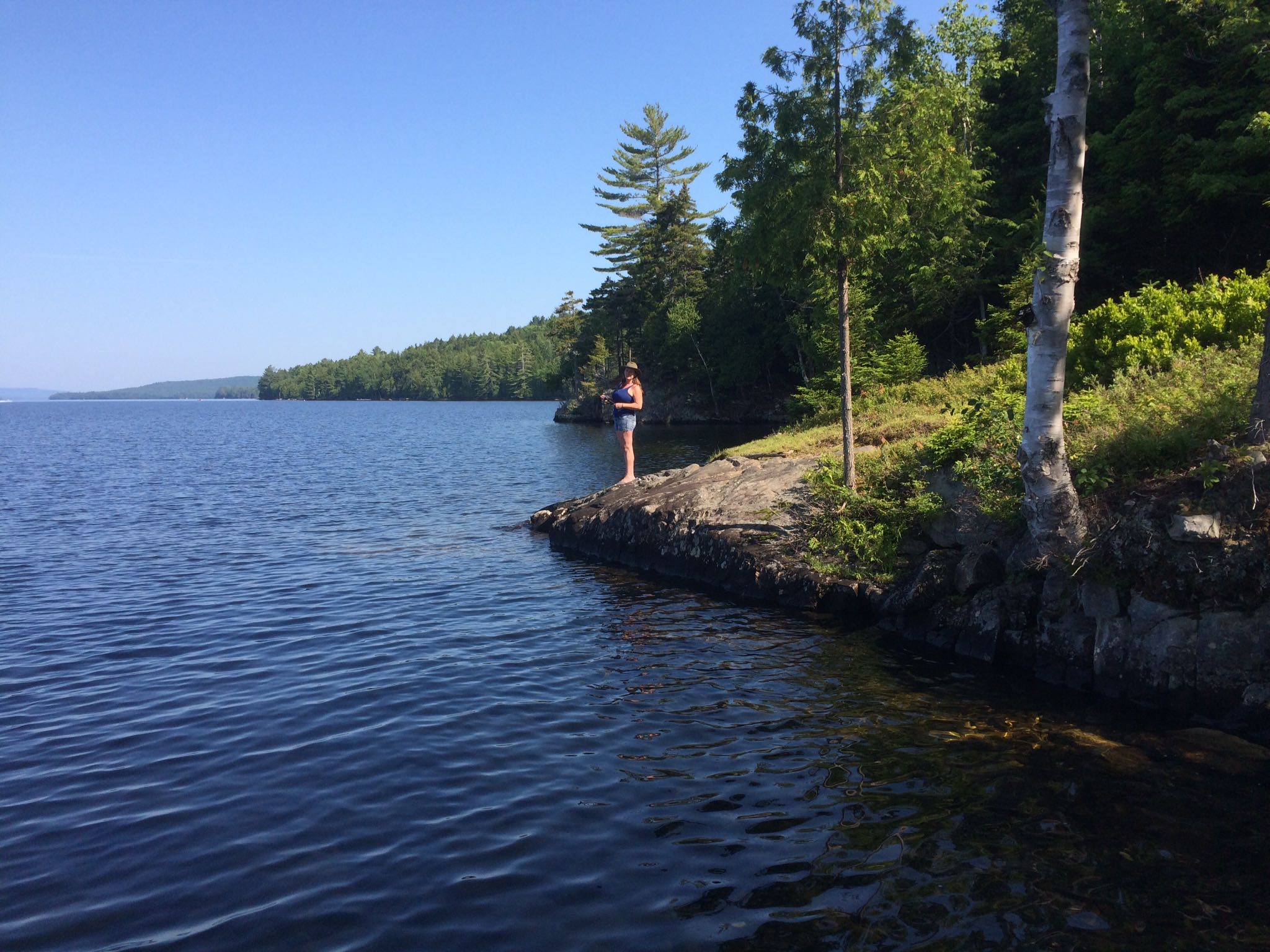
Fisherwoman

Cindy, fishing from the shore of Moosehead Lake, in Beaver Cove

  • Patience
    • Patience is the single most important learning experience acquired while fishing. You see, you never know if and/or when a fish will strike. The body of water could be full of fish, but they may not be hungry. Or, you may have stumbled across a body of water that is fished out. All you can do is try. But, you MUST give it time (not seconds or minutes). Be patient…If a fish doesn’t strike, you can try different bait, a different location on the current body of water, or try another body of water altogether.
    • The key principle here is: A bad day of fishing is better than a good day at work. Enjoy it, regardless!
  • Self-sufficiency – Knowing you can obtain your own food from the land (or water, in this case). 

Cindy and I just completed 5 days at Moosehead Lake. We’ve fished off the shore and a boat, in many locations. We have tried worms and lures. All, to no avail.

Yesterday afternoon, we decided to search out fishing spots by driving along the Eastern side of the lake and happened upon a cove not far from where we are staying. We both cast our bait (worms) using bobbers. We both received hits on our bait, and Cindy’s stuck. She reeled in a whopping 5-6″ small mouth bass 🙂 Not a keeper…

However, at least someone caught a fish!

After reloading our hooks several times, because of the constant hits we were taking from what were likely other very small fish, we decided to try lures. The goal: put out some bait that only a larger fish could get hold of. And, save the remainder of our worms for another day 🙂

We pulled out a couple of trusty Daredevils. Cindy got the new one: I the used one.

We began casting and reeling in.

To our dismay, Cindy got her’s hung-up on something (likely a fallen tree, based on the look of the shoreline). On attempting to get it free I broke the line. The other alternative was (for me) to jump in and swim for it. I decided against that, considering my fractured toe (which also has a nice cut on it, which occurred in the previously reported incident 🙂 ). Plus, I didn’t have my goggles to better explore where the lure was lodged (likely among tons of others that I might get hung-up on myself).

I’d be remiss if I didn’t mention that within minutes of the above occurring, I too lost my Daredevil.

We loaded our gear into the truck and headed back to the lake house.

We’ll try fishing again today and/or tomorrow from my parent’s boat. Wish us luck!

In closing, fishing teaches so many lessons and skills. Above-all, never, never, NEVER give-up! Something that every person should learn, at a very young age.

We’ll explore the other Basic, Must-Have Life Experiences in the next post.

In the meantime, get out there and get some!

Basic, Must-Have Life Experiences – Part 1

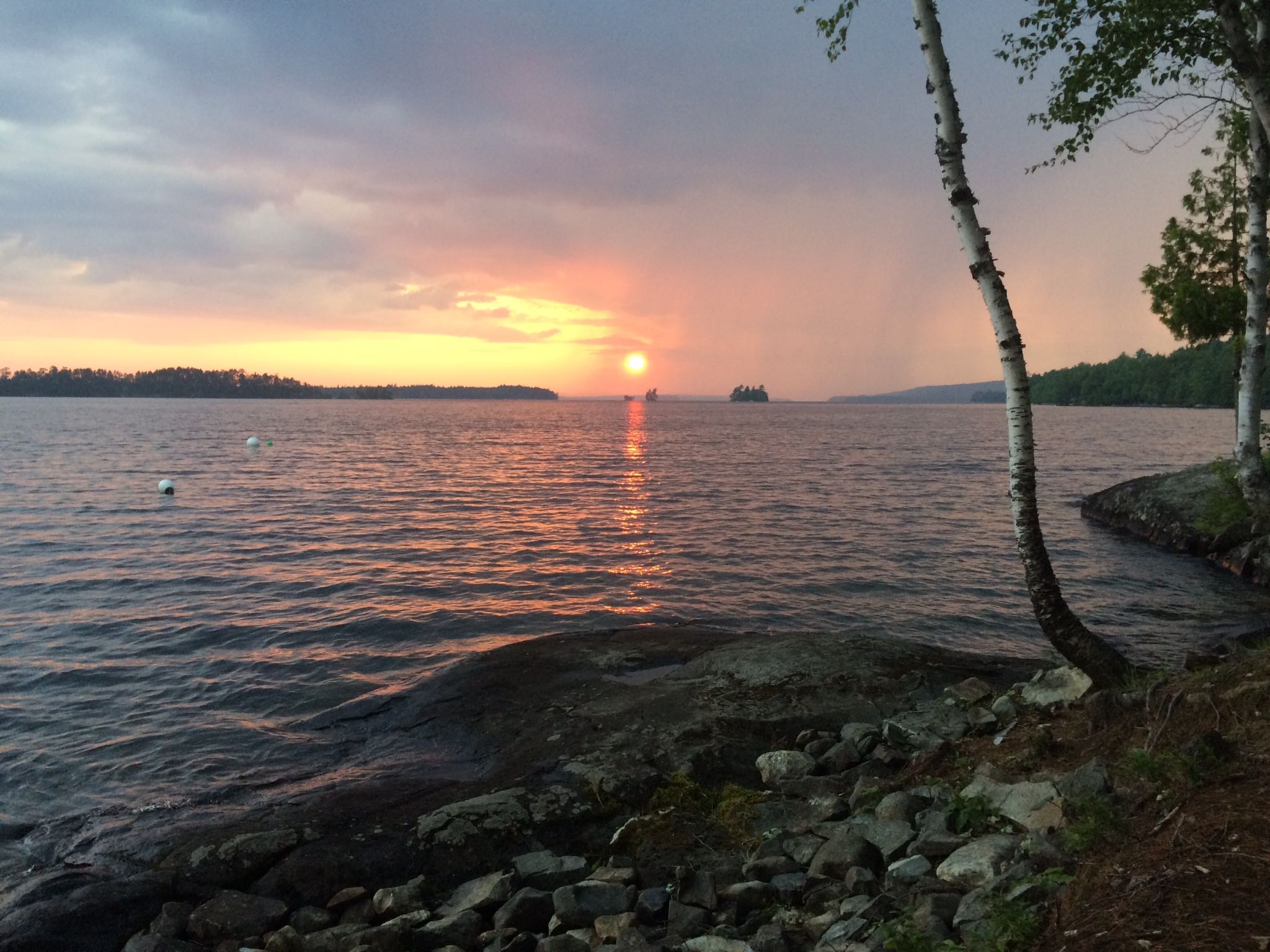
As Cindy, the boys and I sat in a semi-circle of chairs the other night, on the deck viewing the sunset across Moosehead Lake, one of the boys mentioned how crazy it is that people they know haven’t had some of the most basic of life experiences.

sunset

Sunsetting over Moosehead Lake

As we continued the conversation, the following activities were brought up as things we’d consider unfortunate if we had NOT experienced them:

  • Swimming
  • Riding a bike
  • Fishing
  • Building a campfire
  • Shooting a gun

Looking at things a little differently, you might even say these inexperienced souls haven’t had the opportunity to convert a phenomenon (related to the laws of nature) to a life skill.

Phenomenon – a fact or situation that is observed to exist or happen, especially one whose cause or explanation is in question.

You see, anyone reading this has observed the above activities happen on TV, and/or being performed by someone they know. But, until one has personally experienced and mastered the above, the activity remains a mystery…

They ask (consciously or subconsciously) – How DO they do it?!?

Lest you think this topic is whimsical, let’s cover the value of each of these life experiences…

Swimming

Several years ago we had invited neighbors (who have long since moved away) to join us for a swim in our pool.

The kids were in the water within seconds of arrival. The dad and I sat talking, in chairs under the umbrella, until I decided it was time to leap into the pool myself.

Upon inviting the dad to join me he said: No thanks. I can’t swim. I’ve found that I just don’t have the buoyancy of most people.

Man, did my mind spin with possible responses: none of which would have solidified our friendship 🙂

I let it go and enjoyed the cooling swim…

Let’s consider some facts that are realities for ALL humans:

  • About 71 percent of the Earth’s surface is covered in water. That being the case, it would seem to be useful (as well as fun) to be able to safely navigate it “by hand.”
  • The human body is more than 60 percent water (blood is 92 percent water; the brain and muscles are 75 percent water; and bones are about 22 percent water). Since we are all, as far as I can assume, human, then we ALL have the same buoyancy factor.

The ability to swim starts in the mind (belief).

It is so nice to know that our boys can jump off a cliff, into the crystal clear, deep waters of Moosehead Lake (or any body of water on the planet) and swim like a fish. They acquired these skills (of leaping off cliffs and swimming) long, long ago – from observing their father 🙂

I must confess…After the boys headed for home (because they had work the following day) I had a slight mishap. You see, upon diving into the lake from a rock (the big one in the center of the above picture), my big toe hung around with that rock a little longer than the rest of my body. When I hit the water I noticed an undesirable sensation – PAIN!!!

Cindy, the master of broken toes, quickly diagnosed that I have probably fractured mine. Oh well, all in good fun 🙂

Hopefully, this won’t prevent me from competing in our church’s annual Survivor event, taking place in 10 days.

Riding a Bike

I still remember my first experience learning to ride. After much encouragement, my dad launched me on my new bicycle that my grandfather had just purchased for me. I wobbled around a bit and crashed in the grass. We then gave it another shot and I was off. Still a little wobbly, but I was successfully propelling myself across the land.

I had NO IDEA “how” I was doing it. All I really had to think about was one thing: keep peddling and it just seems to work.

Upon learning this skill I had dramatically expanded my horizons with this new form of transportation that was now available to me!

This free mode of transport can be used to travel through the woods of Maine, on the streets of Copenhagen, Denmark (with 100’s of other biking commuters) or across the Golden Gate Bridge, in San Francisco, to beautiful Sausalito.

It is so much more rewarding to view these locations from the seat of a bicycle (up front and personal) vs. behind the closed windows of an air-conditioned vehicle. Not to mention the aerobic exercise it provides.

The ability to ride a bike starts in the mind (belief).

In the spirit of brevity, this concludes part 1 of the topic: Basic, Must-Have Life Experiences.

Get out there, and have some!

p.s. – It is raining this morning at Moosehead Lake. So, Cindy and I are taking a break from the sun as we sit undercover. Hopefully, we’ll see more deer from our vantage point. Last night we observed a sizable buck just feet from the deck, overlooking the lake. We could almost reach out and touch him! It was too dark to take a picture, so you’ll just have to believe me 🙂