Category Archives: Personal Success

Be Careful What You Say – Online!

The online world offers an incredibly rich resource for anyone with Internet access; a tool to enhance our lives and further our career. But, like any “tool”, if we are not careful we can harm ourselves and/or others. In this case, by what we say (post).

Did you know:

  • Anything we post online is a permanent record? While we may post something (on Facebook, for example), and then shortly there-after delete it (I wish I had never said that), it is NOT gone. Facebook makes no guarantees that they wipe our information clean, just because we deleted it (and it is no longer visible — to us).
  • If an investigation was being launched on us Facebook is one of the first places they would go!
  • Things we post online can be used as the grounds for suspension from school, even getting the police involved?
  • Things we post online can cost a job, cause a public relations scandal for our company, even a serious and costly lawsuit?
  • The online world is what is now used by people to investigate their genealogy? Have you ever explored Ancestry.com? If not, check it out! They provide access to TONS of information on our ancestry that was generated offline (way before the Internet, such as census records from over 100 years ago). Just imagine how much Facebook is becoming an ever-increasing resource for this type of activity.
  • Facebook, LinkedIn and other social media sites are an extremely valuable tool for prospective employers to learn about us prior to deciding if they’d like to interview us.

In the past few years I have seen others impacted by unanticipated outcomes resulting from their posts to Facebook. What follows is perhaps an extreme, but an all too real, example.

During one of our recent adventures (outside the country) we met a family of 4 from Europe. He is the CEO of a company and she “was” an employee of the same firm. They also have 2 young children. The husband and wife were still “stinging” from an incident that occurred only weeks earlier. As told by the wife…One evening after a few glasses of wine she posted a racist comment on Facebook. Shortly after doing so (within minutes) she decided to delete the comment. Phew, right?!? Wrong! It was too late. One of her “friends” on Facebook is of the racial descent that she had commented about. Insulted and infuriated, this “friend” had reposted her comment and not long afterwards it was in the hands of the press. You know what the press did with it don’t you. A “hot” story developed in which the comment was fully attributed to the CEO, his company, his wife and employee. A public relations nightmare ensued. The wife was immediately terminated from her post.

After this family had left our table, our boys could only shake their heads in disbelief and one commented: “What a numby!

Considering the potential impacts that can result from our posts it makes good sense, then, to consider a number of principles and guidelines to adhere to, such as:

  • What Mom used to say: “If you can’t say something nice, don’t say anything at all.” That one goes quite far!!!
  • Asking ourselves: “Would I want my children to read this?” I know, I know, some will say “My kids are too young to read.” What if you died today? Our Facebook accounts will NOT be deleted when we cross over to the other side. It is free, remember? As such, it will persist and our children (and grandchildren) will be able to read our complete journal of postings. What kind of example are we setting? Is this the kind of legacy we’d like to leave behind?
  • Asking ourselves: “Is what I’m about to post going to further my career and/or social standing – or shoot myself in the foot?”

We can’t use the excuse: “This is my personal life, which is totally separate from my career.” Wrong! There is only one you and there is only one Internet; wide open to everyone! There is no separation. And, there is far less privacy than you could imagine.

What about freedom of speech? Go for it. Just don’t complain when it is difficult getting a job, or when a job is lost because of something posted online. I’d suggest that the woman in our example above is virtually unemployable. Any potential employer would ask him/herself: “What kind of damage might she do to my company one evening after she has had a few glasses of wine and Facebook at her fingertips?

The key question: Do we want the odds stacked in our favor (for success), or not?

The person who sends out positive thoughts activates the world around him positively and draws back to himself positive results.” ~ Norman Vincent Peale

The Internet and more specifically social media can be used for so many good things. Let’s not let our use of it become a millstone around our neck.

A Skill to Raise The Bridge and Avoid a Crash and Burn

Want to know of another foundational skill that can serve to catapult your career (raise your income) to the next level? A skill that is applicable regardless of industry and the role you play? And, one that just might help you avoid a serious crash and burn?

The skill is: Project Management.

Before we begin, let’s acknowledge a few of the excuses I’ve heard when encouraging people to develop this skill: “That is for people in IT (Information Technology).” Or, “That is a skill for someone at a higher level than I.” Or, “My boss hasn’t assigned me a project and hasn’t suggested I develop this skill, so I guess it isn’t necessary for me.” Wrong, wrong and wrong again!

Bottom-line: Project Management is for ANYONE who must get stuff done with and through other people. If you’d like to elevate your career beyond the level of transaction processing, or the management of status quo, then developing this skill is critically important: to create leverage in your career.

Let’s start by answering the question: What is a project? For this, I’ll reference the authority’s (PMI – Project Management Institute) definition which states:

It’s a temporary group activity designed to produce a unique product, service or result.

A project is temporary in that it has a defined beginning and end in time, and therefore defined scope and resources.

And a project is unique in that it is not a routine operation, but a specific set of operations designed to accomplish a singular goal. So a project team often includes people who don’t usually work together – sometimes from different organizations and across multiple geographies.

The development of software for an improved business process, the construction of a building or bridge, the relief effort after a natural disaster, the expansion of sales into a new geographic market — all are projects.

And all must be expertly managed to deliver the on-time, on-budget results, learning and integration that organizations need. ~ Project Management Institute

And, therefore, “Project Management” is, per PMI’s definition:

The application of knowledge, skills and techniques to execute projects effectively and efficiently. It’s a strategic competency for organizations, enabling them to tie project results to business goals — and thus, better compete in their markets. ~ Project Management Institute

Another common objection I’ve heard when reinforcing the need for Project Management (PM) is “I don’t manage anything BIG enough to warrant putting together a project plan or team. So, Project Management isn’t necessary for what I do.”

Certainly, there are Projects with a big “P” (those involving numerous people, many months of activity, significant budget and risk) and projects with a little “p” (small projects involving a few people and perhaps only a few hours of work).

Let’s illustrate the point of how important PM is, even for small projects. One of the worst crash and burns experienced under my watch was when I was VP of Customer Care for an Internet Services Provider. On my team were people who managed large account relationships. Our company needed to perform an upgrade to a customer’s solution (a company most of you have heard of). This upgrade involved 3-4 people making a handful of tweaks to the customer’s computing environment over the course of a weekend. It was supposed to be simple, risk free and transparent.

It was anything BUT risk free and transparent. In fact, it was a (painful) comedy of errors, going “something” like this. Person A did what they were supposed to do. Person B wasn’t aware of the completion of the prior task and therefore didn’t do their step, and Person C completed their task. Nobody confirmed the completion of the various tasks or spoke with the customer. Monday morning arrives and the customer was ON FIRE with indignation as their site was still down – during the last business day of the month!

How could this happen? There was no project plan. Just a few well-meaning people who thought they were doing the right thing.

In a future post I “may” share the interpersonal exchange necessary to peel the customer off the ceiling. For this post, I’ll share the SIMPLE approach we took to tackle this project the very next weekend. In summary, we:

  • Brought together the 3-4 people involved in the activity.
  • Listed each step that had to be taken, by whom and when.
  • Listed each stakeholder on the project and their 24×7 contact information.
  • Identified the “overseer” (a.k.a. Project Manager) who would monitor the steps, ensure timely completion and effective communications took place amongst all parties (including the customer).
  • Documented all of this in an MS Excel spreadsheet. If I recall, there were less than 15 lines on this rudimentary project plan.

The result, the activity was performed FLAWLESSLY and transparently the following weekend – without incident.

If sound Project Management can benefit such a “small project”, one that took less than 5 hours to complete, it becomes exponentially more important for anything larger.

There are many resources available to develop this skill. If you’d like a quick primer on Project Management, checkout the following:

download

To take things to the next level, visit PMI’s website to locate a chapter near you. They provide PM training, resources and, if you really want a clear point of differentiation on your resume, multiple levels of certification.

As you begin taking on medium to larger-sized projects it will be important to use a comprehensive PM tool such as MS Project. If you don’t have the budget for MS Project (it costs hundreds of dollars) there are free (cloud-based) tools such as Asana which I’ve heard good things about.

As a reminder, PM is but one of a few critical skills that, when developed in conjunction with other foundational skills, can make a big (HUGE) difference in your career. The other foundational / complementary skills (which I’ve previously written about) are:

  • Time Management – To be an effective Project Manager you will need to first demonstrate that YOU are someone who does what you say you will do, when you say you will do it. And, that you are ALWAYS on time. If you aren’t there yet, your efforts to manage someone else’s time will be futile.
  • Interpersonal Management – To define and manage a project requires that you effectively engage and interact with others. I once checked a reference on a PM candidate I was considering. His prior boss said: “This guy is an outstanding PM. He will definitely get the job done. The ONLY issue is that he will leave behind a scorched earth.” I didn’t hire this guy. I want someone with the skills to build relationships to get this (and the next) project done in a way that everyone feels good about; not run over and/or completely burned out by.
  • Public Speaking – While managing a project you will often find yourself leading group discussions (of 3 or 33); in front of your project team or the project’s steering committee. It therefore is important for you to demonstrate competency in this regard.

In closing, Project Management, and the other critical skills mentioned above, are not rocket science. Far from it. Yet, they ARE valuable and applicable to any industry regardless of the role you play. Develop them in concert and you will become an extremely powerful, sought-after and indispensable resource. Sounds like a person who would be pretty secure in their employability, doesn’t it?

You can wait for your boss to push you into developing these skills, proactively ask your manager to invest in your training or you can do it yourself (by funding out-of-pocket). Bottom-line: These skills will serve to catapult you in your career! Go for it, don’t wait; you will NOT be sorry!

Which Curve Am I On?

As far as our lives are concerned, we are either making progress or falling behind. There is no standing still; no treading water. It is important to ask ourselves: “Which curve am I on?”

Another question: Do you know of anyone who disdainfully goes to their job on a daily basis because they “have to”; seemingly trapped in a rut until retirement or the day they die (whichever comes first)? This is a reality for many. Too many.

The mass of men lead lives of quiet desperation.” ~ Henry David Thoreau

There is a better way! And, many have taken that way.

Obviously, it is necessary to earn a living to pay for the important things in life. But, our work need not be drudgery. If we feel our work is drudgery we have choices. We can change our attitude (the way we think about our work), change our employer or both! If we don’t choose one of these options then just maybe we are one of those individuals who are not happy unless we are unhappy. Or, we have succumbed to inertia (a tendency to do nothing or to remain unchanged).

The world owes us NOTHING! If we want something we have to work (go above and beyond) for it!

To make progress (towards changing our attitude and/or our employment) we can do so by simply investing our extra time in learning and personal growth. We all have more time than we care to admit. Just tally the number of hours the one-eyed monster brightens our living room each week. Ouch, I know…

The first step in making progress is deciding:

  • What do I REALLY, REALLY, REALLY want to be doing (for a living, recreation, travel, with my family)?
  • Where do I want to be in 3-5 years (position, title, self-employment, geographic location, income level)?
  • What will I need to do to get there (education, training, engage a mentor, investor(s), bust my hump for sure)?

The reality is that we can do, be, have virtually ANYTHING we set our minds to; and then act on — UNTIL. Until we have achieved the object of our desire.

Whether you think you can, or think you can’t – you’re right.” ~ Henry Ford

This is all about goal setting. We simply need to write down our goals, review them each night before bed and upon rising each morning. Keep them in our face. Post pictures of what we are working towards. My family always knows “what’s next” for us by the pictures on our fridge 🙂

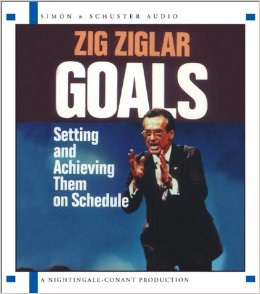
If you’d like more complete training on goal setting, check out the following program. I attended this seminar 20+ years ago. It was absolutely fantastic!

51CAZD5095L._SX258_BO1,204,203,200_

My son Ian recently sent me the following quote:

“The best way to make your dreams come true is to wake up.” ~ Paul Valery

How true!