Author Archives: Craig Bailey

The Strangest Secret

If you haven’t figured it out by now, I’m a big (HUGE) fan of Earl Nightingale.

While he has since passed, his teachings are timeless.

One of his works is called: The Strangest Secret.

In this short audio program he has commentary along the following lines…

Wouldn’t you think that if some great learning experience and knowledge was captured in the past that people would make use of it today? That is, apply it to direct the course of their lives.

The too frequent reality is that, such is NOT the case.

There are NUMEROUS “works” that qualify as wisdom passed down through the ages, including:

  • The Bible: Although, to be fair, without a “tour guide” it “can be” a bit confusing. To this, I’d encourage you to find a good church with parishioners that can help you navigate this outstanding set of books, authored by numerous people.
  • As A Man Thinketh by James Allen: As you begin reading this (free) eBook (ONLY 21 pages) you will find that every single sentence has a ton of wisdom that will cause you to pause on each to give adequate attention and consideration on how it applies to your life.
  • The Strangest Secret and/or Lead the Field by Earl Nightingale.

Note, the first 2 bullets above include a link to the referenced work which you can access for free, online. So, cost is NOT an excuse 🙂

So, what is the strangest secret? Well, it is something that is reinforced in ALL of the above “works”, and many others that have been passed down through the ages. It is, according to Earl Nightingale:

We become what we think about

It was stated by many, in various works and words. A few samples follow:

We become what we think about all day long. Ralph Waldo Emerson

Human beings can alter their lives by altering their attitudes of mind. William James

Watch your thoughts; they become words. Watch your words; they become actions. Watch your actions; they become habits. Watch your habits; they become character. Watch your character; it becomes your destiny. Lao Tzu

Very little is needed to make a happy life; it is all within yourself, in your way of thinking. Marcus Aurelius

What we think we become. Buddha

A man is but a product of his thoughts. What he thinks he becomes. Gandhi

For as he thinketh in his heart, so is he. Proverbs 23:7

As you can see, the strangest secret has been revealed down through the ages; across different religions, societies and professions. And, while the sources of the above quotes may disagree on many things, on this one point they ALL agree!

Why is this?

Because it is based on the the universal law of cause and effect.

Doesn’t thinking precede action? That being the case, if we guide our thinking towards the outcomes we’d like to experience in life then there is really only one way things can go – eventually…

It doesn’t happen overnight or from dumb luck.

The results we seek come from thinking, planning, acting, falling down, getting bruised, getting back up and never giving in!

You might ask: “Why would anybody wait to get started? The sand is running out in ALL of our hour glasses.

To that I’d respond: “You are 100% correct. Let’s not arrive at old age, or the pearly gates, with the regret of not going for it.

All the best!

We Are Responsible For Ourself!

Oh, there is so much wisdom to be found on the trails.

I just completed a 19.6-mile bike ride on the Franconia Notch recreational trail, in northern NH. As I write, I’m sitting at my campsite along the Pemigewasset River (actually, it is more like a stream at this early point of its path) listening to the babbling water on its way south to join the ever expanding flow.

I didn’t know it at the time, but Cindy and I have snowmobiled this “biking” trail. And, we were fortunate enough to do so in 2003 just before the Old Man of the Mountain fell. Today, there is an Old Man viewing area with apparatuses that allow you to get a sense of what the Old Man looked like when he will still mounted high above Profile Lake. More on that later.

I’d have to say that the experience is so much different when you are meandering through the woods on a bicycle, as you seem to have more of an opportunity to stop and glance at the many wonders of nature in this fantastic state park. When on a snowmobile all I want to do is go super fast 🙂 So naturally, I miss a lot of the scenery.

Lafayette Campground, where I’m staying, is right in the middle of the 9+ mile recreational trail (which runs north / south). The gentleman at registration said the northern portion of the trail is steeper while the southern part is more of a gradual slope. My response: No matter. What goes up must come down.

I decided to take on the more difficult section first to get that behind me while I was still fresh. The scenery on this end of the trail was mostly mountains as well as passing a nice spot along Profile Lake. All extremely beautiful!

Note: You can click on any of these photos to expand and get a better view.

NORTH1

The next 2 photos are of the Old Man viewing area. Notice the 6 apparatuses, in the first picture. Each has a figure at the top that, once you align yourself with where the Old Man once was on display, you can get a sense of what it looked like. Each apparatus is designed to provide viewing for people of specific ranges of heights.

OLD MAN APP 2

The following photo provides a sense of what the Old Man looked like from my vantage point on the viewing apparatus. Click on the picture to get a better look.

OLD MAN APP

After making it back to the campground (just over 10-miles completed) I then had to decide if I’d continue riding, by taking on the southern portion of the trail, or go back to camp and relax. I decided to press on.

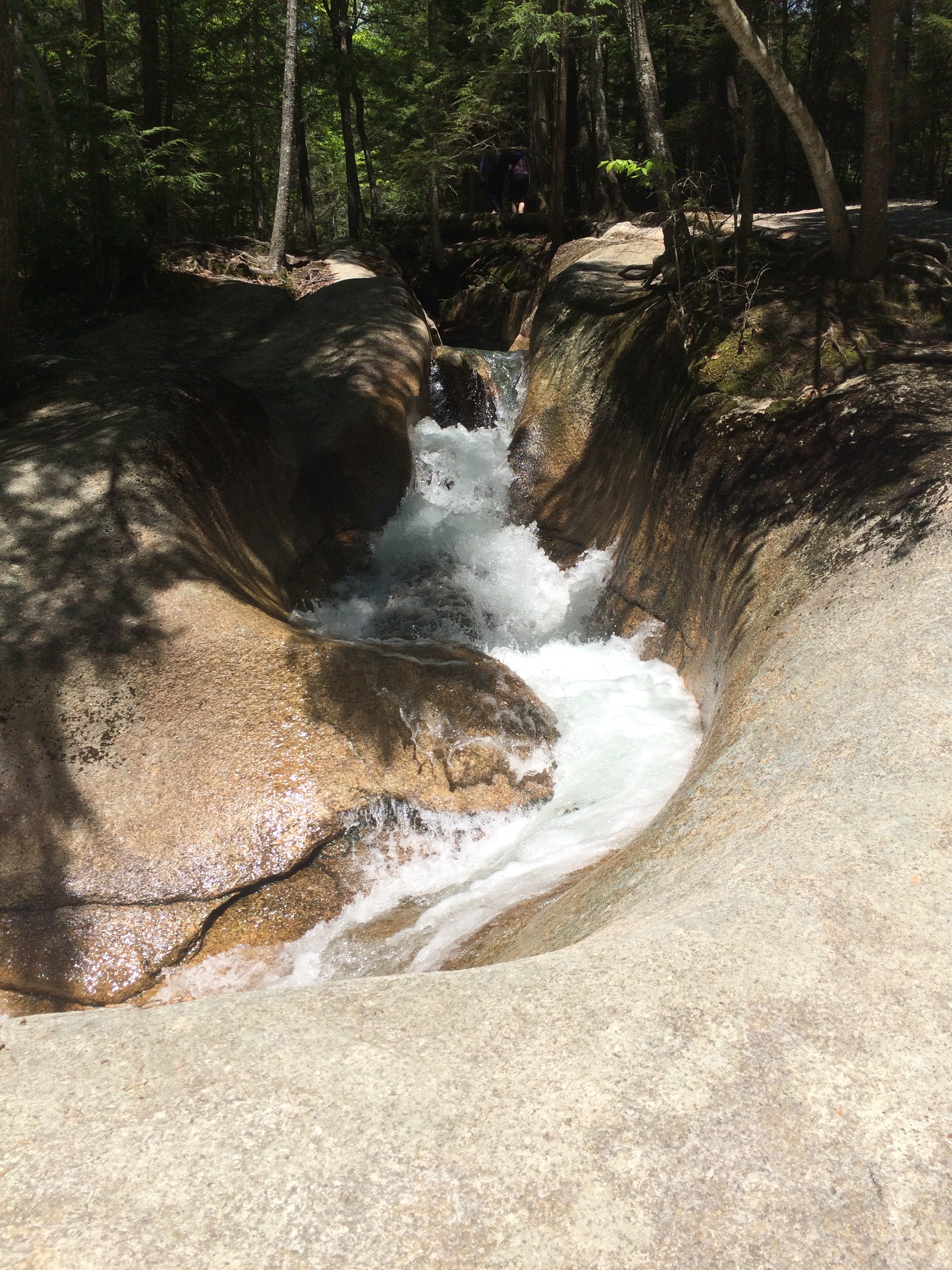
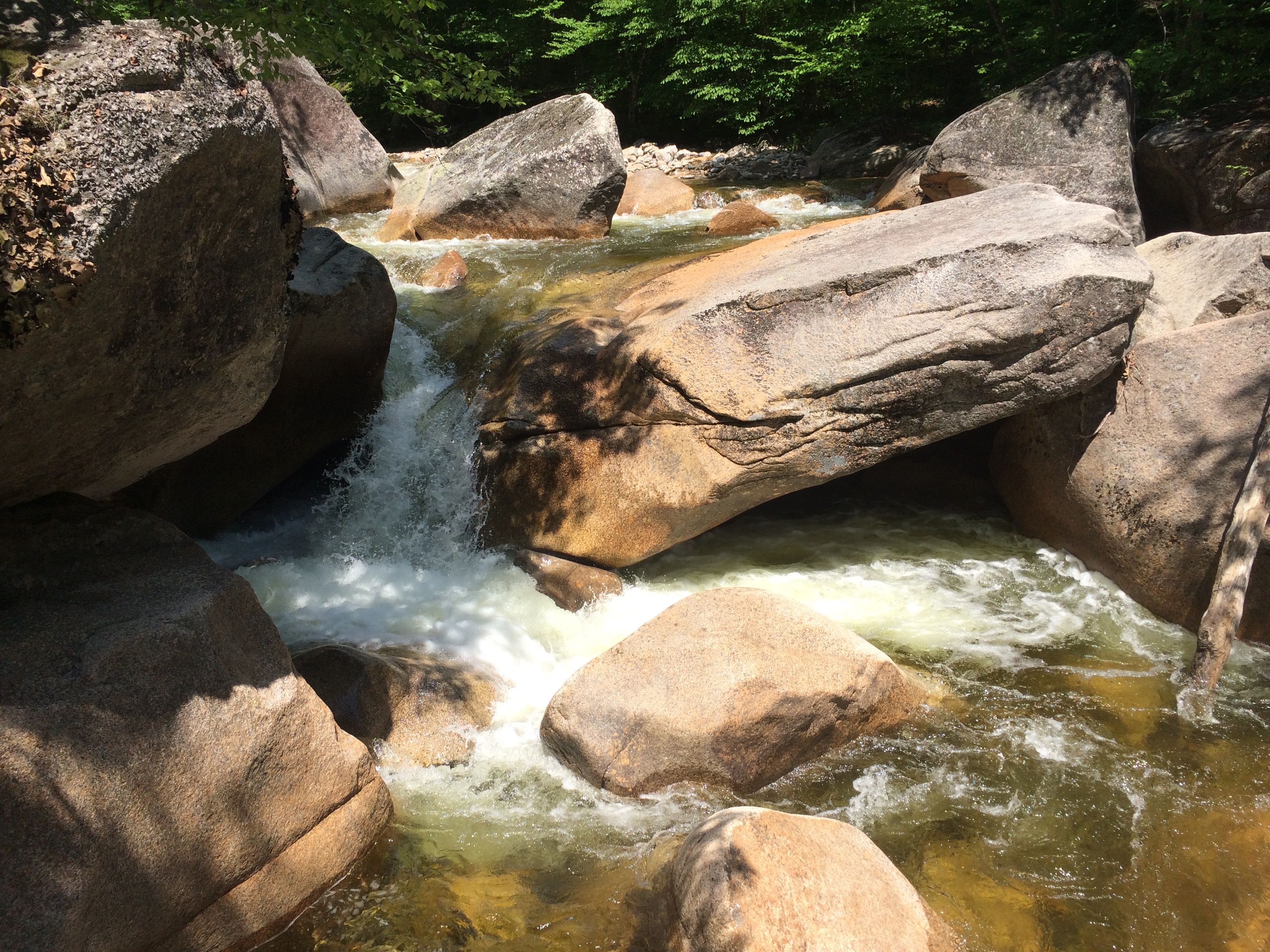
This portion of the trail provides numerous scenic spots along the “growing” Pemigewasset River. Growing, because an increasing number of streams feed the river serving to expand its flow.

The scenes include a number of natural wonders made by flowing water over thousands upon thousands of years.

SOUTH 1

SOUTH 2

SOUTH 3

This is a highly recommended biking excursion that I’ll definitely do again! And, because I did this trip on a Thursday, there were few carbon units (I mean people) to be seen along the trail.

That said, there are 2 drawbacks, which directly result from my being spoiled from our experiences staying on Students Island in the middle of Mooselookmeguntic Lake.

First, the campsite (and much of the biking trail) is alongside route 93. While the highway can’t be seen from the campsite or most of the biking trail, you can definitely hear it. Not a big deal, as you can divert your attention to the babbling waters of the Pemigewasset.

Second, the campsites are fairly close to one-another. On Mooselookmeguntic, the sites are at least 50 to 100 yards apart. You couldn’t hear someone if they hollered. Where I presently sit, I can hear the young family talking “next door.” Just a little too close for comfort, for me 🙂

Lest you think I’m unwilling to share nature, here is a photo of my new friend who I offered some of my peanuts.

Chipmunk

Now, to the point of this post…

The wisdom gathered on this ride was actually found at the northern-most point of the biking trail, when I arrived at an information kiosk at the trailhead for numerous hiking paths to the surrounding mountains.

One of the posters on the kiosk, in bright yellow, read:

HIKER RESPONSIBILITY CODE

You are responsible for yourself. So, be prepared:

  1. With knowledge and gear. Become self-reliant by learning about the terrain, conditions, local weather and your equipment before you start.
  2. To leave your plans. Tell someone where you are going, the trails you are hiking, when you’ll return and your emergency plans.
  3. To stay together. When you start as a group, hike as a group, end as a group. Pace your hike to the slowest person.
  4. To turn back. Weather changes quickly in the mountains. Fatigue and unexpected conditions can also affect your hike. Know your limitations and when to postpone your hike. The mountains will be there another day.
  5. For emergencies, even if you are headed out for just an hour. An injury, severe weather or a wrong turn could become life-threatening. Don’t assume you’ll be rescued. Know how to rescue yourself.
  6. To share the hiker code with others.

Now, if you give the Hiker Responsibility Code more than a cursory glance you’ll see SO MANY parallels with life (outside the woods). I could go through each of the above points and draw these parallels, but I’ll spare you.

Instead, I’ll highlight just a few points that are so important in life:

  • We must EACH become self-reliant by the time we reach adulthood. I have very close family members who had to do so in their early teens. This included figuring out how to live on their own (earning their own room and board) because they were abandoned by their parents. For those of us whom this didn’t happen; we should feel super-blessed.
  • We CANNOT assume that we will EVER be rescued. Not by our parents, other family members, our church or government. To be fair, any one of these “may” be able to provide a lifeline (and again we are “blessed” if that is the case) but we must never assume this is available.
  • Be prepared! This is the easy part. All we need to do is sit down and write out our life plan and then execute. This includes thinking through each path we are considering taking, in advance, and making sure we have all the necessary resources (funding, equipment, back-up plans, etc.) to FULLY SUSTAIN OURSELVES for the journey WE have “chosen.”

In closing…Before anyone freaks out and feels alone, you are not. Just assume that you are and prepare accordingly.

Bottom-line: You are responsible for yourself.

Credit Score – How Important Is This, Really?

I just had the opportunity to perform a minor rescue mission for our youngest son, Evan. You see, he is graduating from high school next week. And, he was supposed to bring his graduation cap and gown to school for rehearsal. But, he forgot it at home. So, I jumped in the Rover and delivered the package just in time for his 8:45am event.

On the way to our high school I passed a few local car dealerships and made an interesting observation.

2 dealerships, in particular, pretty much across the street from one-another, have tantalizing (to some) messages on their billboards. They were:

  1. Credit Forgiveness
  2. Credit got you down? Stop here.

In both cases, they are trying to entice people with a less than stellar credit score to stop in and purchase their vehicle there.

To be clear, most ANYONE can obtain credit (e.g., get a loan) – somewhere. However, the COST of that line of credit is directly based upon our credit score.

The “cost” may include the following factors:

  • Interest rate, or how much we pay for the money borrowed
  • The resulting monthly payment
  • The amount of down payment that must be made
  • The need (or not) of a co-signor
  • Collateral, or what the lender wants to lay claim on if we are unable to pay back that loan

So, our goal must be to maintain the best credit score possible, to minimize the cost of any line of credit we may need to obtain (for a credit card, home mortgage or school / auto loan). But, how does one do this? And, are we REALLY in control?

Like most things in life: we are 100% in control! We must simply take charge!

First, it is important to discuss the make-up of our credit score. We’ll then cover how our credit score is interpreted by lenders (and others) who rely upon this information to make decisions about our credit (and other) worthiness.

I use Mint (a free, online financial management application provided by Quicken). You can learn more about my experience and recommendations using Mint as outlined in several posts, by clicking here. What follows is some very user-friendly information I’ve gleaned from Mint…

What makes-up our credit score?

Following are key attributes, in the order of impact.

  • Credit Usage: Makes up to 30% of our credit score. Unlike other credit attributes, credit usage has no history and is re-calculated every month. More specifically, Credit Card Usage shows how much we spend on credit cards as a percentage of our total available balances (our credit limits) for all of our credit cards. A high percentage could indicate that we don’t have our spending under control and could be a greater risk for defaulting on our payments. As such, it is important to try and keep our credit card usage under 30%.
  • Payment History: Plays a critical part in determining our score. Making payments on time shows potential lenders how reliable we are in paying back what we owe.
  • Derogatory Marks: Indications of poor behavior in the past when it comes to being responsible about credit. These include accounts in collection, liens, and bankruptcies—things potential creditors are definitely wary about. No matter the reason, these negative marks will likely stay on our credit report for seven years or more.
  • Age of Credit: The average amount of time we’ve had all of our open credit accounts and has “medium” impact on our credit score. It measures the longevity of our credit history. Opening several accounts in a short period of time may indicate a great level of risk, so avoid opening lots of credit accounts unless ABSOLUTELY required. Be sure, also, to keep our old accounts open with a good payment history for each.
  • Total Accounts: The number of accounts we have, which may be an indicator of how credit worthy lenders think we are. That said, we shouldn’t go crazy and open a lot of accounts, though, because the average age of credit is more significant than the number of accounts when calculating our credit score.
  • Credit Inquiries: A count of all hard credit inquiries placed on our credit report. What makes an inquiry “hard” is when we authorize a lender to get our credit report for their benefit, so they can evaluate us when we apply for a credit card, a loan, or other form of credit. If we get our own credit report or go through an agent such as Mint to get it for us, it’s called a soft inquiry and it does not affect our credit score.

Now, some might ask: Who the heck tracks all this stuff, and where do they get the information? The answer, is quite simple: There is a credit monitoring big brother, who knows EVERYTHING about our credit worthiness.

In summary, there are 3 credit reporting agencies (Equifax, Experian and Transunion). These agencies receive information from all forms of credit providers including, but not limited to:

  • Credit Card companies, including department store (ALL forms of credit cards)
  • Mortgage companies
  • Banks
  • Etc.

The credit reporting agencies receive this information and then render a credit score based upon our credit providers’ experience with us. So, taking into account the attributes that make up our credit score, these 3 separate agencies provide a score to anyone inquiring upon our credit worthiness.

It is now important to understand how our credit score is interpreted…

Interpretation of our credit score

At a high-level, there are ranges of credit worthiness. Following are general guidelines on the scoring / ranking (this may vary depending on the lending institution):

  • 280 to 590: Color code = Red which translates to: Poor
  • 590 to 640: Color code = Orange which translates to: Not Bad
  • 640 to 720: Color code = Light Green which translates to: Good
  • 720 to 850: Color code = Dark Green which translates to: Excellent

Bottom-line: The lower the score the more difficult it will be to obtain credit and the more costly it will be, from those willing to provide us credit, due to the high risk (based on our past performance). And, conversely, the higher the score the more likely that we can easily obtain credit and the lower the cost it will be.

So far, we have covered the importance of a good credit score as it relates to obtaining credit. But, did you know, that employers are increasingly checking the credit score of job applicants? Make sense to me! That is, if I’m about to hire someone I want to know if they are reliable (in ALL aspects of their life). And, their credit score is an indicator of their financial reliability. So, I want to know this.

Realizing that we all need some form of credit and our score can impact many aspects of our life it becomes crucially important to take steps to create and protect our credit score by ensuring we:

  • Establish good credit early – For those just starting out (teenagers graduating from high school etc.) a good first step is to apply for a no-fee credit card. The credit card company will likely issue a card with an available line of credit in the neighborhood of $300. Once the card is received, however, do NOT consider this free money. It is not. It is very expensive money. Instead, use the card to buy gas for the car and other normal expenses. Then, pay it off EVERY month – without exception. Doing so is a first step in establishing credit history so that when you apply for a larger line of credit it will be less costly to you.
  • Minimize credit usage – Not only is this important to maintain the highest possible credit score, but it also dramatically lowers the cost of living. That is, every time we buy something on credit (and don’t pay that balance off each and every month) the more the acquired item or service costs us. If you are struggling with debt (like I was), you are encouraged to read my article on Debt Eradication by clicking here.
  • Make all payments on time, every time (even if it’s just the minimum payment due), and remember that all types of credit payments count!
  • Protect our credit profile by ensuring that no-one can take out a line of credit in our good name. There is a simple and (almost free) way to do so. Click here to view my article covering this topic.
  • Watch it like a hawk – If you use Mint, they offer a free credit score dashboard that is updated monthly. Doing so ensures we know exactly where we stand and if things are getting better or worse.

Now that you know how crucially important our credit score is you are now in control. Right?

Right!

All the best!