Monthly Archives: April 2014

Time to Cut Another Cord (Cost)?

Still paying for a landline telephone (for the home), even though each family member has a cell?

We cut that cord many years ago, for 2 reasons:

  1. 99% of the time the landline phone rang it was a telemarketer. It was hardly ever for me, or at least someone that I wanted to talk to. If someone wants to talk to me, they call my cell! The same applied for the rest of my family.
  2. It was a perfect example of a negative draw on my net worth, with no value in return. I HATE that 🙂

Common objections and things we had to work through prior to killing the landline included:

  • “What if my babysitter needs to call me, or someone else in an emergency, while I’m away?” New criteria for selecting a babysitter: They must have a cell phone (although, our family is WAY beyond the need for a babysitter at this point).
  • I don’t want to have to carry my cell phone around with me while at home.” Question: Do we carry our landline phone around with us at home? And, if we were to miss a call because we couldn’t get to the phone quickly enough, doesn’t it roll to voice-mail or an answering machine. The same can happen with a cell phone.
  • What about my doctor, bank and other important people that need to reach me?” Give them our cell number!
  • I don’t want to make my cell number too available as I’ll then get calls at times and places when I don’t want to be interrupted.” We can choose when to answer our cell, just like any other phone. For example: I don’t answer my cell when the number isn’t in my contact list. My kids will say “Dad, what if someone is calling you in an emergency?” My response: “If it is an emergency they should be dialing 911. Why would they be calling me? And, if someone REALLY needs to talk to me (when I don’t pick up, because their number isn’t in my contact list or I’m not available) they can leave a voice message and I will call them right back.
  • What about having a phone available for my young child, who doesn’t yet need or can’t afford their own cell phone?” Good question! An option to consider would be an Internet-based phone service that can accomplish everything a landline phone can, for less.
  • And, finally, the worst of all: “It is only $30 per month.

Let’s run this through our monthly cost times 12 (months) times 10 (years) formula to determine the true cost of having this archaic thing, called a landline phone, still collecting dust in our homes. The answer: $3,600!

My wife and I recently returned from The Bahamas celebrating our 25th anniversary. The trip was less than it would have cost to maintain a landline phone over the past 10 years. I’m glad we cut the cord as you could say this (more than) funded our trip 🙂

Suggestion: Take a few moments to tally up the “small” / individual savings opportunities shared in this blog, to see what they amount to. 3 words come to mind: “A Small Fortune!” The tally will be shared in a future post once it is made more painfully obvious why it is so important to kill or reduce expenses that provide NO long term value and serve to delay the timeframe for achieving financial independence.

More to come 🙂
Questions and Taxes

Since our boys have a job (or jobs) they get to experience the “pleasure” of preparing their own tax return. So far, they qualify for the EZ form. However, because the EZ form isn’t all that easy, tax time results in me being bombarded with questions: “Where do I find the form, what does this mean, how do I calculate that?“, etc.

The approach I’m now taking is to have them sit down at the kitchen counter – together. And, I indicate: “You have a total of 10 questions you can ask me, between you. Use them wisely. First, try to figure it out amongst yourselves. If you agree that you need help ask, knocking one available question off the list.” It has now become a fun exercise with much laughter.

During this year’s session, one of my sons asked: “What if I put in the wrong number?” I responded: “This happened to your brother a couple of years ago. The IRS fixed it for him and gave him the correct refund.” To which he responded: “How did they know the right number?” My answer: “They take the information provided by you, the W2 from the company you work for and the 1099-INT from your bank and validate the numbers and calculations.” My son flips out and asks: “Then why am I doing this tax return if the IRS is doing it?!?!?!

I explained: “It is not that simple, as there are variables the IRS does not know about that could impact your tax return. But, the question is a good one.” I therefore didn’t count this barrage of questions against their quota 🙂

The question made us think…Considering the fact that financial institutions and employers provide the IRS with the “basic” information necessary to prepare a tax return, there would seem to be a tremendous opportunity to streamline the tax filing process that could reduce our (the taxpayers’) costs and time. Let’s start real small (focusing on “EZ” filers). What if?

  • The IRS took the “basic” information they receive about us from employers and financial institutions (i.e., W2’s, W4’s and 1099’s) and apply it against our social security number. I imagine “something” like this is being done already! More importantly, this information could be made available to us online to support the following…
  • The “potential” EZ-filer log’s in to a myIRS.gov-type site to validate / confirm the information.
  • The necessary questions are asked to confirm the person qualifies for EZ filing.
  • If the taxpayer is an EZ-filer they simply populate the remaining information / variables on the EZ form and hit submit. They are done!

Doing so would significantly reduce the use of paper, stamps and (most importantly) numerous errors that I imagine the IRS deals with related to basic taxpayer information (especially from inexperienced filers). I realize an e-file option exists. But, it is 100% driven by the taxpayer collating this “basic” information. As such, it is impacted by the taxpayers’ ability to understand the forms and populate the information for filing purposes.

My intent isn’t to solve world hunger (I mean government bureaucracy and inefficiencies) with this post. The point: It is important to reinforce the benefits of asking good (TOUGH) questions. Doing so ensures we don’t become complacent with “this is just the way things have always been.” When possible, let’s find or create a better way!

In closing, let’s keep asking the question: “Why am I doing this?

p.s. – Anyone out there have a connection with the IRS that could build on this idea 🙂

Moving From Worry to Action!

It is important to listen when our spidey senses are tingling. They are telling us that something needs attention. It could be our health (I really need to exercise more), education (I hope I ace that upcoming test), family (I need to spend more time with…), finances (Am I saving enough for retirement?), job (I need to coordinate that meeting to address…) and the all-encompassing “What if…?”

However, we must ask ourselves “Am I just worrying or am I doing something about it?

One definition of worry is: give way to anxiety or unease; allow one’s mind to dwell on difficulty or troubles.

Worrying is like putting our car up on blocks, starting the engine and putting our foot to the floor. Our wheels are spinning to be sure. But, we have no traction and are burning fuel with absolutely no forward momentum or positive outcome. We are wasting valuable energy that could otherwise be put to good use.

At a high level, there are 2 sources of worry:

  1. Things we can do something about (areas in our control).
  2. Things we can do nothing about (areas outside of our control).

Let’s address the 2nd item 1st. For things we can do “absolutely” nothing about the best approach is to change our attitude (instead of continuing to “rail against reality”) and focus our energy on things we CAN do something about.

Several years ago a good friend was planning an overseas mission trip to a third world country. With any trip there are details to consider to ensure safety and comfort. In this case, there were many additional variables including: several modes of transportation through numerous countries (planes, trains, automobiles and border crossings), not knowing the local languages along the way (will I be able to communicate, read the signs, miss my stop?), comfort (over 24 hours of travel under these conditions with minimal sleep) and finally ensuring everything comes together (will we accomplish our objective of helping some people in need?).

As she was discussing the upcoming trip it was clear she was worrying (as any of us would!). An epiphany that was shared (which I “believe” helped) was: When we worry about things we often fast forward through numerous potential scenarios and possible outcomes — in an instant. Yet, the reality is that we seldom encounter these potential scenarios in a single “flash”, if they happen at all.

I am an old man and have known a great many troubles, but most of them never happened.” ~ Mark Twain

More often than not when situations do present themselves, they occur “individually” providing ample time to address each. While that may be what happens in the “real world”, we dramatically accelerate things in our “thought world.” Our brains are extremely powerful; they work at lightening speed and can easily overwhelm us if we don’t control our mind and appropriately direct our thoughts.

So, when our spidey senses are “lit up” let’s use that energy to:

  • Think – What is the issue (or issues) I’m concerned about? What are the options and ideas that I can consider in response?
  • Plan – Which idea(s) should I execute on, when, how and with whom?
  • Act – Put the plan into action – Immediately!

The reason why worry kills more people than work is that more people worry than work.” ~ Robert Frost

Because our brains work at lightening speed this simple process (think, plan and act) need not take days or even hours. We can use our incredibly powerful minds to go from worry to action in MINUTES!

We all worry (to some extent). The key is to quickly detect when we are in the worry-mode and convert that energy into action!

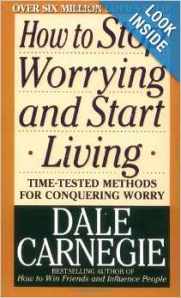
Want a fantastic book on conquering worry? Check out this recommended reading:

download (1)